1–6%
of women may be affected by vaginismus, though true prevalence may be higher

Confidential care for women's sexual health, entirely online
Vaginismus — the involuntary tightening of the pelvic floor muscles that makes penetration painful or impossible — is one of the most misunderstood and undertreated conditions in women's sexual health. It is not a personal failing. It is not permanent. And you do not need to manage it alone, or explain yourself in a clinic waiting room.
1–6%
of women may be affected by vaginismus
90%+
success rate with matched treatment
0
physical examination required to begin
The vaginismus meaning, in clinical terms, is a sexual pain disorder where the pelvic floor muscles around the vaginal opening tighten involuntarily during attempted penetration. This automatic muscle response can make sex painful, difficult, or impossible, even when a woman feels relaxed, aroused, and emotionally connected.
Symptoms may include burning, stinging, discomfort, or inability to tolerate penetration during intercourse, tampon use, or pelvic examinations. Vaginismus does not affect sexual desire, arousal, or the ability to experience orgasm.
It is different from other causes of painful sex, such as infections, endometriosis, vulvodynia, or hormonal changes. Accurate diagnosis is important because treatment varies depending on the underlying cause. At unTaboo, sexual health doctors assess symptoms and create a personalised treatment plan to help women regain comfortable, pain-free intimacy.
1–6%
of women may be affected by vaginismus, though true prevalence may be higher
2 types
Primary and secondary vaginismus — each with different causes and treatment paths
90%+
success rate reported in women who complete a properly matched treatment programme
1–6%
of women may be affected by vaginismus, according to research
Higher
true prevalence is believed to be higher, since many women never seek treatment
3 reasons
Embarrassment, stigma, and lack of awareness are the leading barriers to seeking care
Understanding which type of vaginismus you have is the first step to knowing what caused it and what will resolve it most effectively.
Present from the very first attempt at vaginal penetration — whether during intercourse, a gynaecological examination, or tampon use. The woman has never experienced pain-free penetration. Primary vaginismus most commonly has a psychological root: fear of penetration, religious or cultural messaging that sex is painful or wrong, childhood messages about the body being shameful, or deep-seated anxiety about intimacy. It can also occur in women with no obvious psychological history — reflecting a conditioned reflex that developed without a single identifiable cause.
Develops after a period of pain-free penetration. Something changes — a painful delivery, a gynaecological procedure, a sexual trauma, a pelvic infection, menopause-related tissue changes, or an emotionally significant relationship event — and the body begins associating penetration with pain or threat. The pelvic floor learns to protect itself, and the protective reflex persists even after the original cause has resolved.
Vaginismus is a conditioned mind-body response — meaning the brain and nervous system have learned to associate vaginal penetration with pain, threat, or loss of control, and the pelvic floor muscles respond by contracting as a protective reflex.
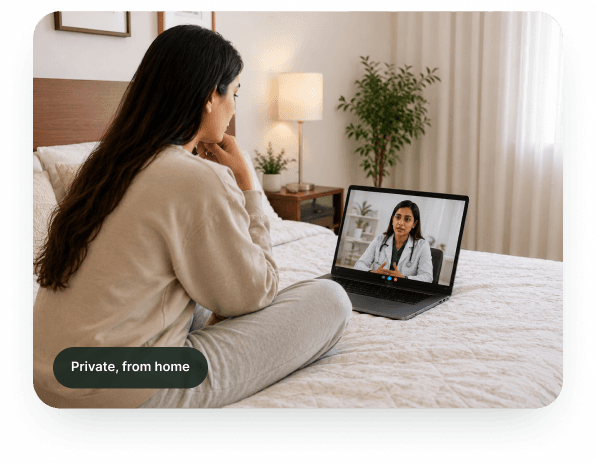
Most women with vaginismus avoid seeking diagnosis for months or years because the thought of a physical examination feels impossible. At unTaboo, diagnosis does not require a physical examination. It is conducted entirely through a structured clinical interview and your own reported symptom history — online, privately, with a doctor who specialises in exactly this condition.
Your unTaboo doctor will assess your symptom pattern, whether penetration is impossible or painful, your psychological and relationship history, pain in non-sexual contexts (smear tests, tampon use), and whether any physical conditions need to be ruled out.
Vaginismus is highly treatable — with success rates above 90% in women who complete a properly matched treatment programme. unTaboo builds personalised multimodal treatment plans that combine the following evidence-based modalities:
CBT identifies beliefs and fears maintaining the reflex. Sensate focus rebuilds intimacy gradually. Trauma-informed therapy supports PTSD-rooted cases. Mindfulness trains the nervous system to tolerate sensation without threat.
Smooth, graduated medical devices gently retrain the vaginal muscles and nervous system. A structured programme — guided by your doctor and therapist — starts small and advances only when comfortable.
A specialist addresses muscle patterns, trigger points, and coordination. unTaboo coordinates referrals to verified pelvic floor therapists in your city.
Where dryness, tissue sensitivity, or localised pain contributes, topical lidocaine gel or oestrogen-based creams may ease discomfort during dilator therapy.
For severe vaginismus that has not responded to other treatments, Botox can temporarily relax involuntary spasm. This is not a first-line treatment.
| Treatment Option | Best Suited For | How unTaboo Delivers Care | Typical Duration |
|---|---|---|---|
| Psychosexual Therapy (CBT) | Primary vaginismus; fear-based; anxiety | Online therapy sessions | 6–12 weeks |
| Trauma-Informed Therapy | PTSD / sexual trauma-rooted vaginismus | Online therapy — specialist referral | Variable; patient-paced |
| Progressive Dilator Programme | All types — physical desensitisation | At-home, guided by doctor + therapist | 4–12 weeks |
| Pelvic Floor Physiotherapy | Physical muscle dysfunction component | In-person referral in patient's city | 6–10 weeks |
| Sensate Focus | Relationship anxiety; couple re-engagement | Online couple's therapy sessions | 6–12 weeks |
| Topical Lidocaine / Oestrogen cream | Menopause-related; tissue sensitivity | Prescribed online; home-applied | Immediate per use |
| Botulinum Toxin (Botox) | Severe, treatment-resistant vaginismus | Specialist referral | One-time procedure |
.png)
Many women search for vaginismus exercises to understand what treatment actually involves day to day. These are typically introduced gradually and under the guidance of a doctor or pelvic floor therapist, rather than attempted alone without support:
Slow, deep belly breathing helps calm the nervous system's threat response before and during any exercise, reducing the automatic pelvic floor guarding reflex.
Learning to consciously identify and release tension in the pelvic floor muscles — the opposite focus of a Kegel exercise, which strengthens rather than relaxes.
Starting with the smallest graduated dilator and progressing at your own pace, only advancing once the current size feels comfortable and pain-free — never on a fixed timeline.
Gradual, private, non-goal-oriented touch to reduce fear and disconnect associated with the vaginal area, often introduced early in a CBT or sensate focus programme.
Structured, non-penetrative touch exercises that rebuild physical intimacy and trust without the pressure of intercourse as the end goal.
Practised during exercises to help the body stay present rather than anticipating pain, which is often what triggers the muscle spasm in the first place.
Because vaginismus is a conditioned reflex, exercises work best as part of a structured, doctor- or therapist-guided programme rather than in isolation — attempting dilator use or exposure exercises without proper pacing or support can sometimes reinforce fear rather than reduce it.
If you're asking how to cure vaginismus, the most important thing to understand is that recovery almost always requires addressing both the physical and psychological components together — not one in isolation.
Confirming whether your vaginismus is primary or secondary, and identifying whether the root cause is psychological, physical, or both, shapes everything that follows.
Psychosexual therapy addresses the fear response, while a graduated dilator programme retrains the physical reflex — together, these consistently outperform either alone.
Couples who go through treatment together, including sensate focus, often see faster and more lasting improvement.
Recovery timelines vary widely — some women see meaningful progress in weeks, others need several months, particularly with trauma-rooted vaginismus.
A structured, supervised programme significantly improves outcomes compared to unguided attempts, and helps avoid reinforcing the fear response through poorly paced exposure.
Yes — can vaginismus be cured is one of the most common questions women ask, often after years of believing the condition is permanent or untreatable. With a properly matched, multimodal treatment programme, success rates above 90% have been reported in women who complete treatment. Both primary and secondary vaginismus respond well to combined psychosexual therapy and progressive physical desensitisation, and most women see meaningful improvement within 6–12 weeks. Trauma-rooted cases may take longer but are still highly treatable with the right, trauma-informed support.

.png&w=1200&q=75)
Vaginismus is rarely only one person's experience. Partners of women with vaginismus carry their own confusion, worry, guilt, and — over time — sometimes resentment or self-blame. Neither the woman nor the partner is at fault.
The woman may feel broken, ashamed, and responsible for the relationship's sexual limitations. The partner may feel helpless, rejected, or afraid of causing pain — and begin to withdraw from intimacy entirely. Both may avoid the subject because neither knows how to raise it without causing hurt.
Couples who go through vaginismus treatment together — with joint education, couples therapy, and co-participation in sensate focus — consistently report stronger relationships after recovery than before vaginismus was diagnosed. unTaboo offers couples consultation sessions and online couples therapy for exactly this reason.
Begin your vaginismus treatment through a confidential online consultation. No in-person examination is required to start care.
Our doctors and therapists specialise in vaginismus, sexual pain disorders, pelvic floor concerns, and psychosexual therapy.
For women affected by anxiety, sexual trauma, or fear of penetration, our specialists provide compassionate, evidence-based care in a safe environment.
Consult from home through encrypted video appointments. Your consultations and medical information remain confidential and secure.
Complete a brief clinical questionnaire covering your symptom history, triggers, psychological context, and relationship situation.
Your doctor conducts a full clinical assessment via encrypted video, establishing your vaginismus type, likely causes, and treatment pathway. No physical examination required.
Your plan may include online psychosexual therapy, a guided dilator programme, pelvic floor physiotherapy referral, and prescription medication where appropriate.
unTaboo's qualified therapists deliver sessions via private video on the same platform as your medical consultation.
Your doctor and therapist track your progress and adjust your plan at your pace, without pressure or deadlines.
Vaginismus is not something you caused. It is not something you have to live with. And it is not something you need to manage alone or explain in a clinic waiting room. Thousands of women across India are recovering from vaginismus through unTaboo — with certified sexual health doctors, qualified therapists, personalised treatment plans, and complete privacy. The first step is a 5-minute questionnaire. The rest happens at your pace.
Vaginismus is a sexual pain disorder where the pelvic floor muscles around the vaginal opening tighten involuntarily during attempted penetration, making sex painful, difficult, or impossible even when a woman feels aroused and emotionally connected.